With Brave. Kind. Me., In Harmony Music brings together experienced musicians, educators, and former students to create children’s music with the songwriting, production, and emotional depth of a serious artistic project.
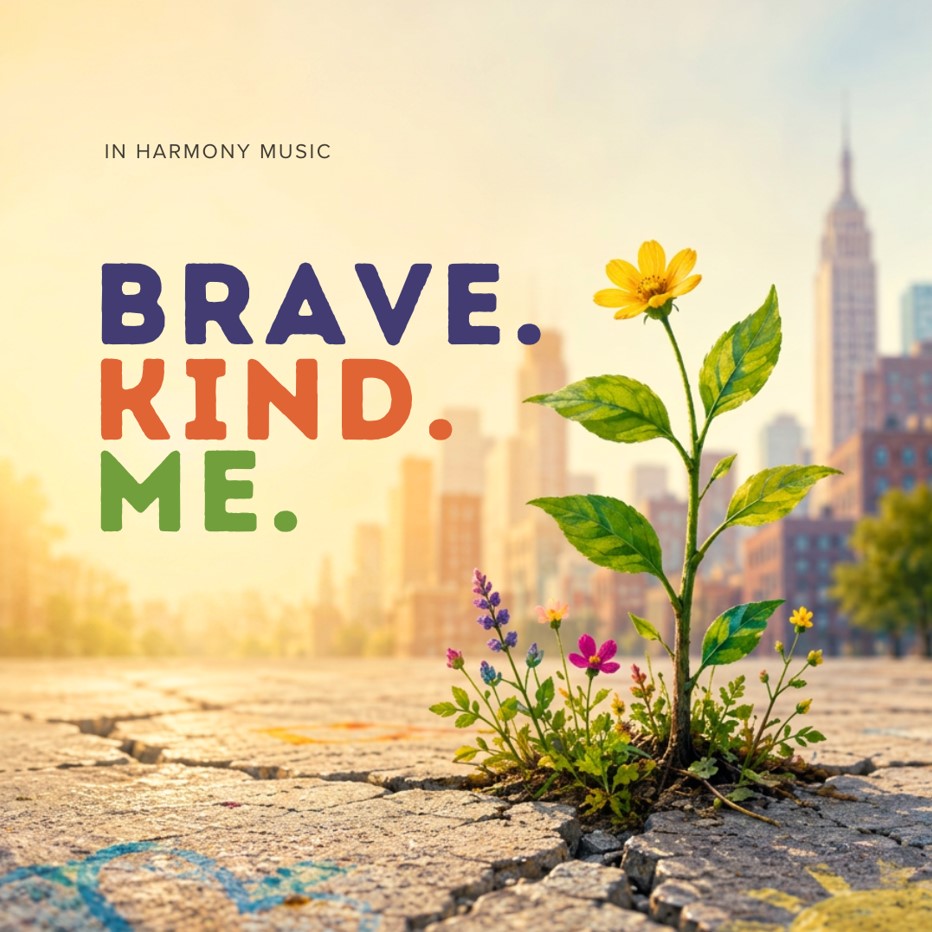
For much of its history, children’s music has existed in a category of its own, often separated from the broader musical conversation. It is expected to be accessible, cheerful, and educational, but rarely held to the same artistic standards applied to music created for adults. In Harmony Music is part of a growing effort to challenge that distinction. Its newest album, Brave. Kind. Me., released August 30, approaches children not as passive listeners, but as a discerning audience deserving of thoughtful songwriting, sophisticated musicianship, and music that recognizes the complexity of growing up.
The distinction matters because children encounter music long before they have the vocabulary to explain what music means to them. A melody can become associated with a particular classroom, a friendship, a family ritual, or a moment when a child felt understood. A song can give language to an emotion that is difficult to articulate. When musicians recognize that capacity, music created for children becomes more than a teaching tool. It becomes part of the architecture of childhood.
That philosophy has shaped In Harmony Music since its founding in 2003 by Justine Chadly. For more than two decades, Chadly has worked at the intersection of music, education, movement, and child development, building an approach that places connection alongside musicianship. Brave. Kind. Me. represents a natural evolution of that work, while also marking an important creative statement about what children’s music can become when professional artists take the audience seriously.
A Different Standard for Children’s Music
The album does not attempt to make children’s music more sophisticated simply for the sake of appearing sophisticated. Its strength is that the artistic ambition is integrated into the material itself. Songs such as We All Belong, My Friends, A Little Bit of Love, Elbow Macaroni and Baila explore friendship, empathy, confidence, inclusion and self expression without losing the playfulness that makes music meaningful to children.
The result is music that can operate on several levels at once. A child can dance to Baila, laugh along with Elbow Macaroni or sing We All Belong without needing to understand the larger ideas embedded within the songs. Adults, meanwhile, can recognize the emotional and social themes beneath the surface. That duality is one of the album’s most compelling artistic qualities.
Creative Director Tom Foote brings another dimension to the project. A drummer, producer and composer associated with Rhythm Kids, Foote has spent decades creating music for children and educators around the world. His experience allows the production to retain energy and accessibility while maintaining the musical integrity expected of a professional recording.
Together, Chadly and Foote have approached the album with the understanding that children do not need music simplified to the point of losing its character. They need music that invites them in.
When Former Students Become Collaborators
Perhaps the most remarkable element of Brave. Kind. Me. is not simply who created it, but who returned to help create it.
Several of the artists featured on the album were once students of Chadly. Years later, they are established musicians in their own right, returning to contribute their talents to a project connected to their own musical beginnings.
There is something unusually powerful about that progression. Music education is often discussed in terms of skills acquired, performances completed or opportunities made possible. The longer arc is rarely considered. A teacher may spend years introducing a child to rhythm, movement, confidence and creative expression without knowing where that experience will eventually lead.
For Chadly, the album offers a tangible expression of that legacy. Former students are no longer simply recipients of a musical education. They are artists participating in the continuation of the work.
That makes Brave. Kind. Me. both a new recording and a reflection of the community that has developed around In Harmony over more than twenty years.
The Musicians Behind the Music
The album also reflects the importance of collaboration within contemporary music. Boston based saxophonist and recording artist Pat Loomis contributed to several tracks, bringing additional instrumental depth to the project. His assessment of the recording has centered on the quality of its songwriting, singing, production and arrangements, particularly the sense that the project raises expectations for what children’s music can accomplish.
That observation speaks to a larger shift taking place across the creative industries. Increasingly, audiences are less interested in rigid categories and more interested in whether the work itself is compelling. Children’s music does not need to imitate adult music to earn artistic respect. It simply needs to be made with the same seriousness of purpose.
In Harmony understands that distinction.
The musicianship does not exist to make the album appear impressive. It exists because the songs deserve it.
A Record That Can Live Beyond the Classroom
The most successful children’s music often escapes the environment for which it was originally intended. A song introduced by a teacher becomes something a child sings at home. A classroom activity becomes a family ritual. A melody heard during a workshop becomes part of a child’s memory years later.
That possibility is evident in the early response to Brave. Kind. Me. During a recent In Harmony teaching workshop, educators quickly connected with Elbow Macaroni, Baila and We All Belong. One educator responded particularly strongly to the beauty of We All Belong, while another immediately imagined Elbow Macaroni becoming a classroom favorite.
Those reactions reveal something important about the album’s design. The music does not depend on a formal lesson plan to have value. It can function within education while remaining music first.
That distinction may ultimately be one of In Harmony’s greatest contributions to the field.
Taking the Audience Seriously
There is a tendency to underestimate children because their tastes are still developing. Yet children are remarkably perceptive listeners. They respond to rhythm, repetition, humor, emotion and authenticity. They know when something feels genuine.
Creating for that audience therefore requires more than simplifying a concept or adding a catchy chorus. It requires understanding how children experience the world.
Brave. Kind. Me. approaches that responsibility with unusual care. Its songs do not lecture children about kindness or belonging. They create musical spaces where those ideas can be experienced.
That is a subtle but significant creative decision.
Rather than telling children what they should feel, the album gives them opportunities to participate, move, sing and recognize themselves within the music. It allows emotional ideas to emerge through experience rather than instruction.
Twenty Years of Work, One New Creative Chapter
The album also represents a larger moment for In Harmony Music. What began with Chadly’s vision in 2003 has developed into a broader ecosystem involving educators, musicians, families, schools, libraries, therapists and community partners.
Through the In Harmony Foundation, that work extends to communities supporting children who may be experiencing isolation, trauma or disconnection. Music, movement and play remain central, but the underlying philosophy is consistent: connection is not separate from learning. It is part of how learning becomes meaningful.
That philosophy gives Brave. Kind. Me. a context that extends beyond its twelve or so minutes of music. The album is one expression of a much longer creative practice, one that has spent decades observing what happens when children are permitted to participate fully in music.
Perhaps that is why the album feels less like a collection of children’s songs and more like a continuation of a musical conversation.
A New Conversation About Children’s Music
The future of children’s music may not depend on making the category more like mainstream music. It may depend on removing the artificial hierarchy that separates the two.
Children can appreciate beauty. They can recognize complexity. They can respond to excellent musicianship. They can remember a song for years. Most importantly, they deserve to be given music created with the assumption that their inner lives are as rich and complicated as anyone else’s.
Brave. Kind. Me. makes that case quietly but convincingly.
Its greatest achievement may be that it never seems to be trying to prove anything. The quality of the work speaks for itself. Experienced musicians bring their craft. Educators bring their understanding of children. Former students bring the perspective of artists who have grown beyond the classroom. Chadly brings more than two decades of experience. Foote brings a lifetime of musical production and performance.
Together, they create something that belongs to children without talking down to them.
And perhaps that is where the future of children’s music begins: not with making music smaller for its audience, but with making the audience large enough to deserve the very best music we can give them.
Learn more about In Harmony Music: InHarmonyMusic.com
Follow In Harmony Music: Instagram | Facebook | YouTube
Follow In Harmony Foundation: Instagram | YouTube